Annotation Is Moving Up the Stack
Models now draw most of the boxes and write most of the first- pass labels. The human work that remains is smaller in volume, harder in kind, and more consequential per decision.
When Meta’s research group built the dataset behind its Segment Anything Model, it needed outlines, known as masks, for objects in millions of photographs. The final dataset contains 1.1 billion masks across 11 million images, far more than any previous segmentation dataset.
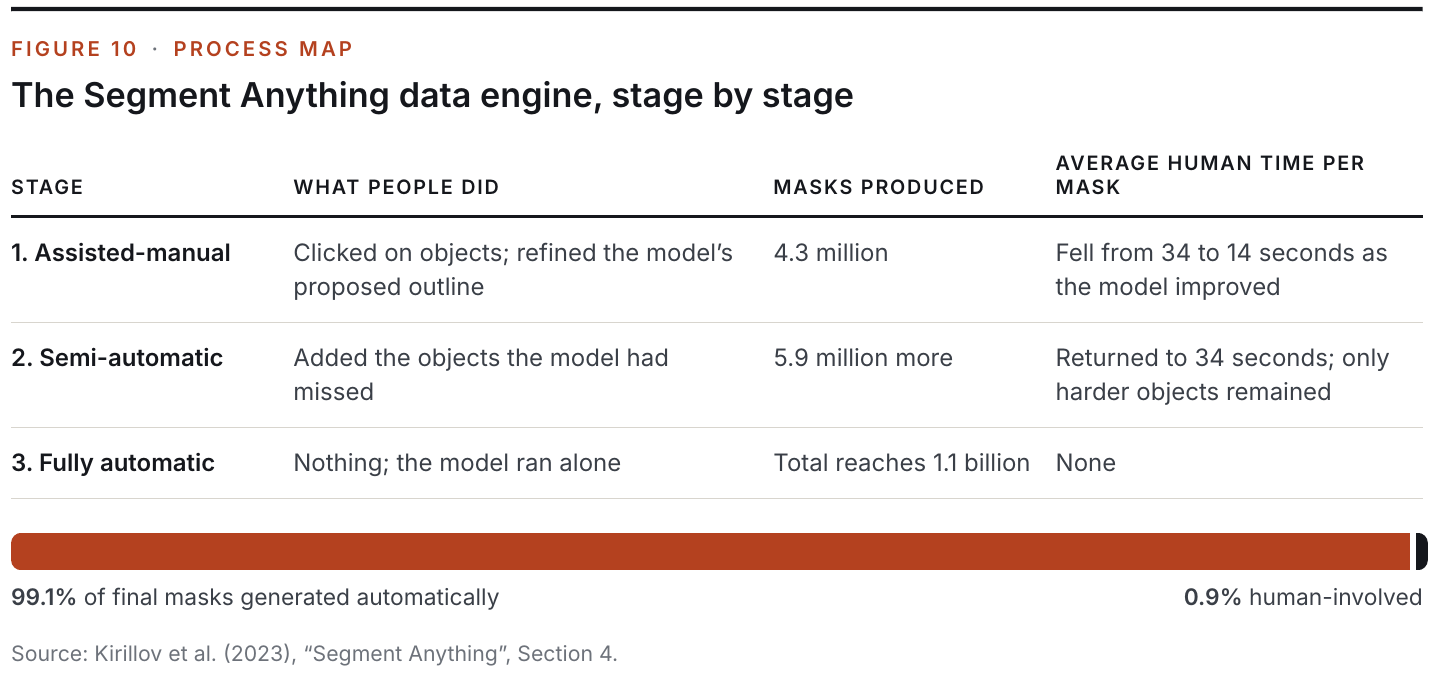
Human annotators drew almost none of them. According to the paper, 99.1% of the masks were generated fully automatically.
It would be easy to read that as the end of manual annotation. The details of how the dataset was built suggest something more interesting.
How a data engine works
The team describes a three-stage process it calls a data engine.
In the first stage, professional annotators labelled masks by clicking on objects, with an early version of the model proposing an outline for them to refine. As the model was retrained on their output, it improved, and the average time to annotate a mask fell from 34 seconds to 14. This stage produced 4.3 million masks.
In the second stage, the model automatically labelled the objects it was confident about, and annotators were asked to add the ones it had missed. Their work became harder: the remaining objects were the less obvious ones, and average time per mask went back up to 34 seconds. This stage added 5.9 million masks.
In the third stage, the model ran alone and generated the rest.
Three things stand out. Human effort was front-loaded: about 10 million human-involved masks made the next billion possible. The human task changed as the model improved, from drawing everything to finding what the machine had failed to see. And the time per human-labelled item did not fall in the long run. It fell while the model was absorbing easy work and rose again once only hard work remained.
That pattern, a shrinking volume of human work that grows harder per item, appears wherever AI-assisted annotation has been studied.
Language models as annotators
Text annotation has moved in the same direction, with large language models acting as first-pass labellers.
A widely cited 2023 study in PNAS by Gilardi, Alizadeh and Kubli compared ChatGPT with crowd workers on classification tasks over tweets and news articles: relevance, stance, topic and framing. With no task-specific training, the model’s accuracy exceeded that of crowd workers on most tasks, and its consistency across repeated runs exceeded that of both crowd workers and trained annotators. The cost per annotation was under a third of a US cent, more than an order of magnitude cheaper than the crowd.
Earlier work had already shown that annotation could be partly programmed. The Snorkel system lets subject-matter experts write labelling functions, simple rules or heuristics that each label some examples imperfectly, and then combines them statistically. A case study at Google reported that this approach let teams build classifiers using organisational knowledge in place of large volumes of hand labels.
So for a large class of tasks, the first-pass label is now a machine’s. The evidence on what follows is more mixed.
What the optimistic reading leaves out
Performance varies by task, unpredictably. Follow-up studies testing language models across many annotation tasks found accuracy ranging from excellent to poor, with no reliable way to tell in advance which a new task would be. Pangakis and colleagues, after testing across a range of social-science tasks, titled their paper with its recommendation: automated annotation with generative AI requires validation. That means human-labelled data for every new task, to check the machine against.
The comparison baseline was weak. Crowd workers on general-purpose platforms are not the standard a professional annotation operation should be measured against. Showing that a model beats anonymous, lightly screened workers on tweet classification says little about how it compares with trained annotators on a client’s own taxonomy, and less about expert tasks.
Consistency is not correctness. A model gives the same answer every time, which looks like reliability. As the agreement article argued, it is reliability in the narrow sense. A model that systematically mislabels a category will do so with perfect self-agreement.
Humans anchor on suggestions. When people review machine output instead of labelling from scratch, they tend to accept what they see. Studies of pre-annotation in corpus linguistics found gains in speed and consistency along with a measurable pull toward the pre-annotator’s errors. The broader literature on automation bias, reviewed by Parasuraman and Manzey, shows that this tendency affects experts as well as novices and is not eliminated by training or instructions to be careful.
The annotators may already be using the model. Veselovsky and colleagues estimated that a third to nearly half of crowd workers on one text task used a language model to produce their answers. Where that happens, “human review” of machine output is partly the machine reviewing itself.
The new job description
If the machine produces the first label, the human contribution moves to four places.
Specification. Somebody decides what the categories are, what counts as an instance, how edge cases resolve. With a language model as annotator, this takes the form of a prompt and a set of examples, but it is the same intellectual work as writing an annotation guideline, and the quality of everything downstream depends on it.
Verification. A sample of machine labels must be checked against human judgement, per category, on an ongoing basis. This is a measurement task. It needs labels produced independently of the machine, by people who have not seen its answer.
Exception handling. The items the model is unsure about, or that fall outside what it has seen, go to people. As in the second stage of the Segment Anything engine, these are by construction the hard cases.
Adjudication. When model and human disagree, or two models disagree, somebody with the authority and knowledge to decide has to decide.
Each of these is more skilled than drawing boxes. An annotator in this system needs to understand the task well enough to notice when a plausible-looking output is wrong, which is a harder cognitive demand than producing an answer unaided.
Designing against anchoring
The central design problem of AI-assisted annotation is that review is cheaper than labelling only if reviewers stay critical, and the evidence says they tend not to. Several countermeasures have support.
Blind a sample. Have a proportion of items labelled from scratch by humans who never see the machine’s output. Compare. This is the only clean estimate of the machine’s error rate and of how much reviewers are anchoring.
Seed known errors. Insert items where the pre-label is deliberately wrong and measure how often reviewers catch them. A reviewer who approves planted errors is not reviewing.
Show uncertainty, and hide certainty. Route low-confidence items to full human labelling with no suggestion shown. Reserve the review-and-approve mode for items where the model is reliably right.
Rotate the suggestion source. If two different models pre-label, and their disagreements are surfaced to the human, the reviewer is prompted to think instead of confirm.
Watch the override rate. If reviewers change almost nothing, either the model is excellent or the review is nominal. The seeded-error test distinguishes the two.
Does the human share go to zero?
The strongest form of the automation argument is that these are transitional problems. Models are improving quickly. If a model can label at expert level, review becomes unnecessary.
For some tasks that is already close to true, and for those tasks human annotation at volume should stop. The Segment Anything result is a case where a model, bootstrapped by people, reached a point where its automatic masks were judged to be of high quality in the authors’ own review.
But notice what cannot be automated by construction. A model cannot be the independent check on itself: verification requires a signal from outside. A model cannot define what the organisation wants the categories to be. And the cases a model handles worst are, by definition, the cases where its labels are least trustworthy and a human’s are most needed.
There is also a moving frontier. Each time models master a class of labels, the valuable data becomes whatever lies just beyond: rarer cases, finer distinctions, more specialised domains, judgements about quality instead of category. The second stage of the data engine is the general pattern.
What this changes
For any model-assisted pipeline, maintain a blind, human-only labelled sample as the reference. Without it you have no error estimate.
Measure reviewer performance with seeded errors, not with agreement with the pre-label.
Route by confidence: automatic acceptance where the model is verified reliable, unassisted human labelling where it is not.
Expect AI assistance to lower unit cost and to raise the skill required of the remaining human workforce. Price and staffing should reflect both.
Ask suppliers what share of labels are machine-generated, how they are verified, and what measures counter automation bias.
Validate LLM-based labelling on your own task before relying on it. Published results on other tasks do not transfer.
The useful description of modern annotation is a control system: a model that proposes, people who specify and verify, and instrumentation that shows whether the people are still exercising judgement. The labour content per label falls. The design content rises. An operation that still measures itself in items per hour is measuring the part of the work that machines have taken over.
- Kirillov, A. et al. (2023). “Segment Anything.” IEEE/CVF ICCV.
- Gilardi, F., Alizadeh, M. and Kubli, M. (2023). “ChatGPT outperforms crowd workers for text-annotation tasks.” Proceedings of the National Academy of Sciences.
- Ratner, A. et al. (2017). “Snorkel: Rapid Training Data Creation with Weak Supervision.” Proceedings of the VLDB Endowment.
- Bach, S. et al. (2019). “Snorkel DryBell: A Case Study in Deploying Weak Supervision at Industrial Scale.” ACM SIGMOD.
- Pangakis, N., Wolken, S. and Fasching, N. (2023). “Automated Annotation with Generative AI Requires Validation.” arXiv preprint.
- Ziems, C. et al. (2024). “Can Large Language Models Transform Computational Social Science?” Computational Linguistics.
- Tan, Z. et al. (2024). “Large Language Models for Data Annotation and Synthesis: A Survey.” EMNLP.
- Fort, K. and Sagot, B. (2010). “Influence of Pre-annotation on POS-tagged Corpus Development.” ACL Linguistic Annotation Workshop.
- Parasuraman, R. and Manzey, D. (2010). “Complacency and Bias in Human Use of Automation: An Attentional Integration.” Human Factors.
- Veselovsky, V., Ribeiro, M. H. and West, R. (2023). “Artificial Artificial Artificial Intelligence: Crowd Workers Widely Use Large Language Models for Text Production Tasks.” arXiv preprint.
The data foundation enterprises trust to build reliable AI, since 2021.