The Bottleneck Moved
Compute and architecture still matter. But the scarce input in applied AI is increasingly the data that tells a model what good looks like.
In 2022, a team at OpenAI reported a result that should have unsettled anyone who believed model size was the main story. Human evaluators were shown outputs from two language models and asked which they preferred. One model had 175 billion parameters. The other had 1.3 billion, less than one hundredth the size. The evaluators preferred the small one.
The difference between the two was not architecture, and it was not compute. The small model had been fine-tuned on a few tens of thousands of examples of human demonstration and human preference. The technique was reinforcement learning from human feedback, and the paper, known as InstructGPT, became the template for how raw language models are turned into usable products.
Read as a data story, the result says something specific. A hundredfold deficit in parameters was more than offset by roughly 77,000 carefully collected prompts, written and ranked by about 40 contractors. That is a small dataset by any modern standard. It is also a dataset that could not be scraped. Somebody had to design the task, recruit and screen the people, write the instructions, and decide what to do when they disagreed.
This is what it means to say the bottleneck moved.
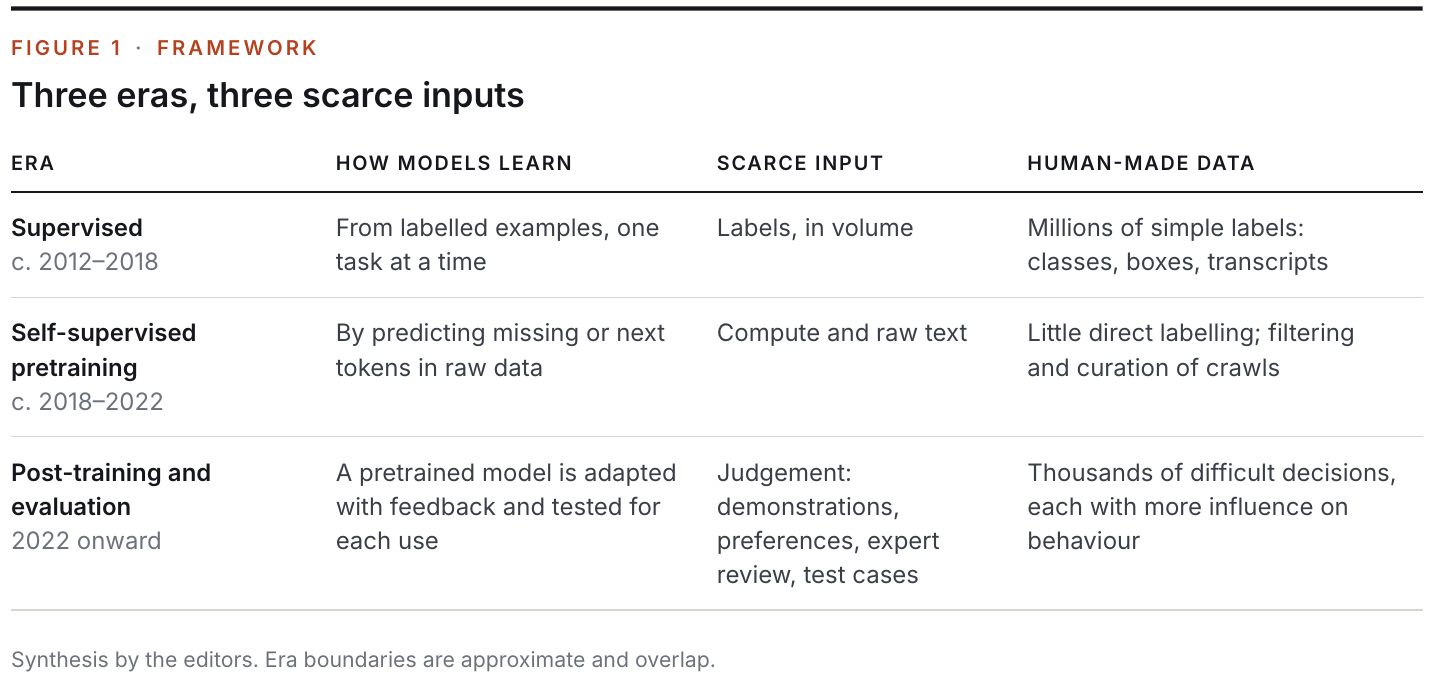
Three eras, three scarce inputs
It helps to be precise about what was scarce, and when.
In the supervised era that followed ImageNet, the scarce input was labelled examples. Progress in vision, speech and translation tracked the availability of large annotated datasets, and annotation was a volume business: millions of images, each needing a class or a box.
Self-supervised pretraining changed that. Models such as BERT and the GPT family learn by predicting missing or next tokens in raw text, which needs no labels at all. For several years the scarce inputs were compute and raw text, and the scaling-law literature formalised the trade. Kaplan and colleagues showed in 2020 that language-model loss falls predictably as parameters, data and compute rise. Hoffmann and colleagues refined this in 2022, arguing that the large models of the day were undertrained and that, for a fixed compute budget, model size and training tokens should grow in roughly equal proportion.
The third era began when pretrained models became good enough to be useful and not yet good enough to be trusted. A raw language model completes text. It does not reliably follow instructions, decline harmful requests or know when to stop. Closing that gap is called post-training, and it runs on human-made data of a new kind: demonstrations of good behaviour, comparisons between outputs, and test cases that define success. The volume is small. In the InstructGPT case it was tens of thousands of items, set against the hundreds of billions of tokens used in pretraining.
The Hoffmann result deserves a second look. It is usually cited as a statement about compute. It is equally a statement about data: a bigger model is only worth building if there is proportionally more text to train it on.
The supply side is tightening
Two lines of evidence suggest that the supply of raw text is not unlimited.
The first is arithmetic. Villalobos and colleagues at Epoch AI estimated the total stock of public human-written text and compared it with the growth rate of training datasets. Their conclusion, published at ICML in 2024, is that if current trends continue, models will be trained on datasets roughly equal in size to the available stock of public human text at some point between 2026 and 2032. The authors are careful to say this is not a hard wall; synthetic data, transfer from other modalities and better data efficiency can all extend the runway. But each of those is, itself, a data-engineering problem.
The second is consent. The Data Provenance Initiative audited 14,000 web domains underlying three widely used training corpora. Its 2024 study found a rapid rise in restrictions aimed at AI crawlers: more than 5% of all tokens in the C4 corpus, and more than 28% of tokens from its most actively maintained, critical sources, were fully restricted by robots.txt, and 45% of C4 was restricted by terms of service. The open web that pretraining depended on is closing, unevenly and fast.
Neither finding means AI progress stops. Both mean that the marginal unit of useful data is getting more expensive to obtain, and more valuable once obtained.
Where practitioners say projects break
The research literature on why applied AI fails points the same way, from a different direction.
Sambasivan and colleagues at Google interviewed 53 AI practitioners working on high-stakes applications in India, East and West Africa, and the United States. Ninety-two per cent reported at least one “data cascade”, a compounding failure that originated in data and surfaced downstream. Nearly half reported two or more. The paper’s title, taken from an interviewee, is its own summary: everyone wants to do the model work, not the data work.
A 2024 RAND study, based on interviews with 65 experienced data scientists and engineers, reached a compatible conclusion. Among the root causes of failed AI projects it identified were organisations lacking the data needed to train an effective model, and teams misunderstanding what problem the data was supposed to help solve.
Analyst forecasts go further. Gartner predicted in early 2025 that, through 2026, organisations will abandon 60% of AI projects that are unsupported by what it calls AI-ready data. That is a forecast rather than a measurement, and should be read as one. But it reflects what the firm’s clients report.
The strongest objection
The best counterargument comes from Rich Sutton’s 2019 essay “The Bitter Lesson”. Its thesis is that, across seventy years of AI research, methods that exploit general-purpose computation have repeatedly beaten methods that encode human knowledge. On this view, careful data work is another form of hand-crafting, destined to be overtaken by scale.
The objection has force, and the history supports it. Hand-built features lost to learned ones. Curated linguistic resources lost to raw text.
But notice what the bitter lesson is actually about. It is a claim about how knowledge should enter a system: through learning, not through hand-coded rules. It says nothing against the importance of what the system learns from. InstructGPT is fully consistent with it. Nobody wrote rules for helpfulness. People produced examples and comparisons, and a general method learned from them.
A second objection is that compute remains a real constraint, and it does. Frontier training runs are limited by chips and power. The claim here is narrower. For the much larger population of organisations that are not training frontier models, compute is available by the hour. A dataset that captures how their domain works is not.
What the shift looks like in practice
The volume of human-made data per model has fallen. Its unit value has risen, and its character has changed.
The supervised era asked annotators questions with answers: is this a cat, where is the pedestrian. The post-training era asks questions that require judgement: which of these two answers is more helpful, is this medical summary safe to act on, did the agent complete the task or only appear to. The people who can answer are fewer. The instructions are harder to write. The disagreements are more informative.
Evaluation has followed the same path. A model that can do many things needs many tests, and each test is a dataset someone has to build, protect from contamination and keep current.
This is why large AI developers have been spending heavily on the organisations that produce such data. In June 2025, Meta agreed to pay about 14.3 billion dollars for a 49% stake in Scale AI, a data-labelling company, according to Reuters and other outlets. Whatever one thinks of the price, nobody pays it for a commodity.
What this changes
Treat post-training and evaluation data as designed artefacts with owners, versions and specifications, in the same way as code.
Before scaling a model, ask whether the limiting factor is capacity or signal. A small amount of well-specified feedback can outweigh a large increase in parameters.
Assume that freely scrapeable data will keep shrinking. Plan for licensed, commissioned and first-party sources.
The foundation model is increasingly a purchased input. Differentiation comes from data that encodes your domain, your edge cases and your standards.
Budget for data work as a continuing operating function, not a one-off project cost that ends at launch.
Ask of every AI initiative: what data would tell us this system is wrong, and who is producing it?
The useful question for an enterprise is no longer “who will label our data” but “what is the smallest amount of expert-made data that changes model behaviour, and how do we produce it reliably”. That reframes the work from throughput to design: task specification, annotator selection, disagreement handling and evaluation become the product. The rest of this series takes those pieces one at a time.
- Ouyang, L. et al. (2022). “Training language models to follow instructions with human feedback.” NeurIPS.
- Kaplan, J. et al. (2020). “Scaling Laws for Neural Language Models.” arXiv preprint.
- Hoffmann, J. et al. (2022). “Training Compute-Optimal Large Language Models.” NeurIPS.
- Villalobos, P. et al. (2024). “Position: Will we run out of data? Limits of LLM scaling based on human-generated data.” ICML.
- Longpre, S. et al. (2024). “Consent in Crisis: The Rapid Decline of the AI Data Commons.” NeurIPS Datasets and Benchmarks.
- Sambasivan, N. et al. (2021). “Everyone wants to do the model work, not the data work: Data Cascades in High-Stakes AI.” ACM CHI.
- Ryseff, J., De Bruhl, B. and Newberry, S. (2024). “The Root Causes of Failure for Artificial Intelligence Projects and How They Can Succeed.” RAND Corporation.
- Gartner (2025). “Lack of AI-Ready Data Puts AI Projects at Risk.” Press release, 26 February. Forecast.
- Sutton, R. (2019). “The Bitter Lesson.” Essay.
- Devlin, J. et al. (2019). “BERT: Pre-training of Deep Bidirectional Transformers for Language Understanding.” NAACL.
- Reuters (2025). Reporting on Meta’s investment in Scale AI, June.
The data foundation enterprises trust to build reliable AI, since 2021.